Products
|
|
| |
Home » Products » Zynapse
citicoline
Zynapse®
FORMULATION:
Each mL of Zynapse 500 contains Citicoline...................125mg
(500mg Citicoline per 4mL ampoule)
Each mL of Zynapse 1000 contains Citicoline....................250mg
(1000mg Citicoline per 4mL ampoule)
Citicoline, a naturally occurring endogenous nucleoside, is an intermediate compound in the major pathway for the biosynthesis of the structural phospholipids of cell membranes, including neurons.
PHARMACODYNAMICS:
When administered orally, it is absorbed almost completely, and its bioavailability is approximately the same when administered intravenously.
Once absorbed, the cytidine and choline disperse widely throughout the body, cross the blood-brain barrier, and reach the central nervous system (CNS), where they are incorporated into the phospholipids fraction of the cellular membrane and microsomes.
The concept that the administration of exogenous Citicoline can augment the synthesis of neural membrane phospholipids is attractive, because accelerated replacement or repair plays a critical role in maintaining the healthy function of numerous physiological processes. It has shown the therapeutic efficacy in a variety of diseases in which membrane disorder, dysfunction, or degeneration result in cellular and tissue ischaemia and necrosis.
PHARMACOLOGICAL PROPERTIES:
Citicoline activates the bio-synthesis of structural phospholipids in the neuronal membrane, increases cerebral metabolism and increases the level of various neurotransmitters, including acetylcholine and dopamine. Citicoline has shown neuro-protective effects in situations of hypoxia and ischaemia, as well as improved learning and memory performance in animal models for the brain aging. Furthermore, it has been demonstrated that Citicoline restores the activity the activity of mitochondrial ATPase and of membranal Na+/K+ATPase, inhibits the activation of phospholipase A2 and accelerates the re-absorption of cerebral edema in various experimental models.
INDICATIONS:
a. Cerebrovascular diseases - e.g. from ischaemia due to stroke, where Citicoline
accelerates the recovery of consciousness and overcoming motor deficit. The clinical
testing of Citicoline has challenged the historical concept that one can do nothing for
a stroke patient after a certain period of time has transpired after the onset of the
symptoms. The practicality of a drug that can be administered up to 24 hours after
stroke is a key factor in evaluating the potential of Citicoline.
The results of a recent phase 3 clinical trials among patients suffering from ischaemia
stroke demonstrated a statistically and clinically significant improvement in the neurological function of patients treated with optimal dose of Citicoline, 500mg daily.
The potential of Citicoline as stroke therapy is underscored by the other key attributes: its oral dosage for, a 24-hour window of therapeutic opportunity following stroke, and an apparent absence of significant side effects. Preliminary evidence suggests that in a small sub-group of patients, Citicoline may reduce the size of the impact caused by stroke.
Treatment of Citicoline within the first 24 hours after onset in patients with moderate to severe stroke increases the probability of complete recovery in 3 months.
b. Head Trauma of varying severity: In a clinical trial, Citicoline accelerated the recovery from post-traumatic coma and the recuperation of walking ability, achieved a better final functional result and reduced hospital stay.
c. Cognitive disorders of diverse aetiology - e.g. senile cognitive impairment which is secondary to degenerative diseases (e.g. Alzheimer's disease) and to chronic cerebral vascular disease. Citicoline improves scores on cognitive evaluation scales and slowed the progression of Alzheimer's disease.
d. Parkinson's disease - Citicoline has also been shown to be effective as co-therapy for Parkinson's disease. Beneficial neuroendocrine, neuroimmunodulatory, and neurophysiological effects have been described. Considerable experimental evidence of effects of Citicoline on CNS dopaminergic system has accumulated. After treatment with Citicoline, regeneration of cells in rats with substantina nigra lesions has been demonstrated. Citicoline increases striatal dopamine and tyrosine hydroxylase synthesis
CONTRAINDICATIONS:
Must not be administered to patients with hypertonic of the parasympathetic.
USE IN PREGNANCY AND LACTATIONS:
There is inadequate evidence of safe use of Zynapse in human pregnancy. Zynapse should be used in pregnancy and lactation only if the potential benefits justify the potential risks.
PRECAUTIONS:
In case of persistent intracranial hemorrhage, the very slow administration (30 drops/minute) is recommended, the administration of larger doses could provoke an increase of the cerebral blood flow.
INCOMPATIBILITIES:
Zynapse must not be administered in conjunction with medication containing meclofenoxate (also known as clophenoxate).
DRUG INTERACTIONS:
Zynapse potentiates the effects of L-dopa.
SIDE EFFECTS:
Occasionally, citicoline may exert a stimulating action of the parasympathetic system, as well as a fleeting and discrete hypotensive effect.
CAUTION:
Food, Drugs, Devices and Cosmetics Act prohibits dispensing without prescription.
DOSAGE:
Zynapse 500 - 125mg/mL Injection: 1 to 2 injections daily
Zynapse 1000 - 250mg/mL Injection: 1 Injection daily
Dosage may be adjusted based on the seriousness of the disease. It can be administered Intramuscularly, intravenously (3 to 5 minute) injection and in intravenous drop perfusion (dripping speed 40-60 drops/minute).
Zynapse is compatible with all intravenous isotonic solutions. It can also be mixed with hypertonic glucose serum. Direct administration in the vein, if it is not made very slowly, can produce hypotension.
AVAILABILITY:
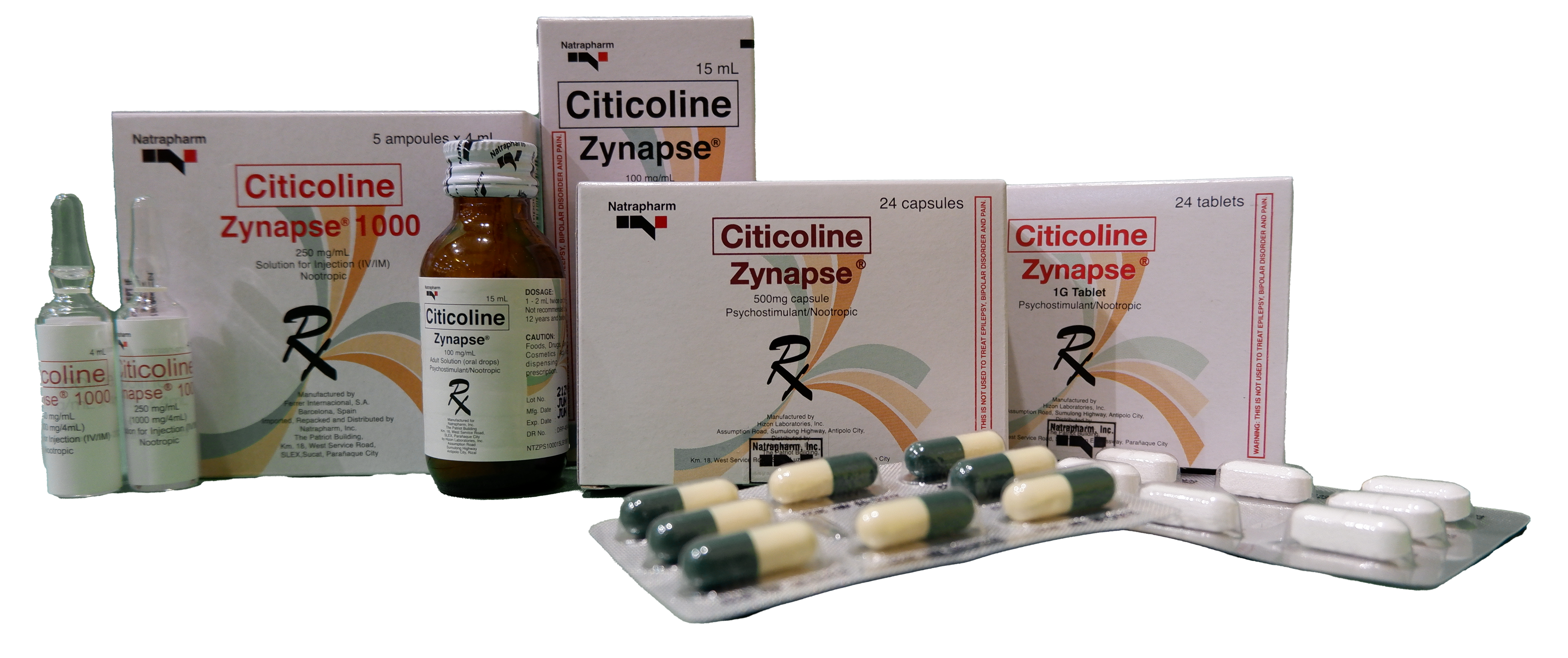
Zynapse 500 - 125mg/mL (500mg/4mL ampoule): Box of 5 ampoules x 4mL
Zynapse 1000 - 250mg/mL (1000mg/4mL ampoule): Box of 5 ampoules x 4mL
ALSO AVAILABLE:
Zynapse 500mg Capsule - Box x 24's
Zynapse 100mg/mL adult oral drops - Bottles x 15mL
STORE BELOW 25°C.
|
|