Natrapharm Home | Contact Us | Sitemap    
   Patriot Pharmaceutical Corp.   
Products

Natrapharm, Inc.

Patriot Pharmaceutical Corp.
 
Home » Products » Curazid


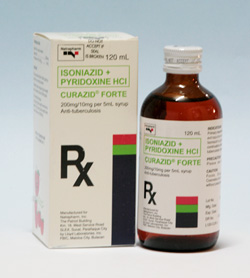
ISONIAZID + PYRIDOXINE HCl

CURAZID® FORTE


FORMULATION:
Each 5mL (1 teaspoonful) contains:
Isoniazid ........................................................................... 200mg
Pyridoxine hydrochloride (Vitamin B6) ........................ 10mg

INDICATIONS:
Isoniazid is indicated for the primary treatment of pulmonary tuberculosis and extrapulmonary tuberculosis. It is administered with other antituberculous drugs usually including rifampicin and pyrazinamide. Isoniazid is also used in high risk subjects for the prophylaxis of tuberculosis. Isoniazid is given in the initial and continuation phase of short-course tuberculosis regimens.

ADVERSE EFFECTS:
Isoniazid is generally well tolerated at currently recommended doses. However, patients who are slow acetylators of isoniazid appear to have a higher incidence of some adverse effects. Also, patients whose nutrition is poor are at risk of peripheral neuritis which is one of the commonest adverse effects of isoniazid. Other neurological adverse effects include psychotic reactions and convulsions. Pyridoxine may be given to prevent or treat these adverse effects. Optic neuritis has also been reported.

Haematological effects reported following use of isoniazid include various anaemias, agranulocytosis, thrombocytopenia and eosinophilia.

Other adverse effects include nausea, vomiting, pellagra, purpura, hyperglyclycaemia, lupus-like syndrome, urinary retention and gynacomastia.

TREATMENT OF ADVERSE EFFECTS:
Pyridoxine hydrochloride 10mg daily has been recommended to prophylaxis of peripheral neuritis associated with isoniazid although some have suggested using up to 50mg daily.

PRECAUTIONS:
Isoniazid should be administered with caution to patients with convulsive disorders, a history of psychosis or hepatic or renal dysfunction. Patients who are at risk of neuropathy or pyridoxine deficiency, including those who are diabetic, alcoholic, malnourished, uraemic, pregnant, or infected with HIV, should receive pyridoxine usually in a dose of 10mg daily, although some have suggested using up to50mg daily. If symptoms of hepatitis such as malaise, fatigue, anorexia, and nausea develop, isoniazid should be discontinued pending evaluation.

Liver function should be checked before treatment with isoniazid and special care should be taken in alcoholic patients or those with pre-existing liver disease.

ANTIMICROBIAL ACTION:
Isoniazid is highly active against Mycobacterium tuberculosis which it inhibits in vitro at concentrations of 0.02 to 0.2 ug per mL. Isoniazid may have activity against some strains of the mycobacteria including M. kansasii.

Although it is rapidly bactericidal against actively dividing M. tuberculosis, it is considered to be only bacteriostatic against semi-dormant organisms and has less sterilizing activity than rifampicin or pyrazinamide.

PHARMACOKINETICS:
Peak concentrations of about 3 to 8 ug per mL appear in blood 1 to 2 hours after a fasting dose of 300mg by mouth. The rate and extent of absorption of isoniazid is reduced by food. Isoniazid is not considered to be bound appreciably to plasma proteins and diffuses into all body tissues and fluids, including to breast milk.

The plasma half-life for isoniazid ranges from about 1 to 6 hours, those who are fast acetylators having shorter half-lives. The primary metabolic route is the acetylation of isoniazid to acetylisoniazid by N-acetyltransferase found in the liver and small intestines. Acetylisoniazid is then hydrolyzed to isonicotinic acid and monoacetylhydrazine; isonicotinic acid is conjugated with glycine to isonicotinyl glycine (isonicotinuric acid) and monoacetylhydrazine is further acetylated to diacetylhydrazine. Some unmetabolised isoniazid is conjugated to hydrazones. The metabolites of isoniazid have no tuber-culostatic activity and, apart from possibly monoacetylhydrazine, they are also less toxic.

In patients with normal renal function, over 75% of a dose appears in the urine in 24 hours, mainly as metabolites. Small amounts of drug are also excreted in the feces. Isoniazid is removed by dialysis.

CAUTION:
Food, Drugs, Devices and Cosmetics Act prohibits dispensing without prescription.

DOSAGE:
Usual adult dose is 300mg daily by mouth on an empty stomach.
Children: 5mg per Kg body weight daily with a maximum of 300mg daily.
For Intermittent therapy, 10mg per Kg body weight three times a week or 15mg per kg body weight twice a week. (maximum of 900mg)
Doses may need to be reduced in patients with hepatic impairment or moderate to severe renal impairment.
In tuberculosis prophylaxis, daily dose of 300mg are given for at least 6 months and sometimes for up to 1 year.
Or as prescribed by the physician.

AVAILABILITY:
Bottles of 120mL

The Company

Corporate Services

Careers at Natrapharm
Home | The Company | Corporate Values | Corporate Services | Products | About the Philippines | Careers | Contact Us | Sitemap
©2008 . Powered by ASPAC/LAW