Products
|
|
| |
Home » Products » Surmontil
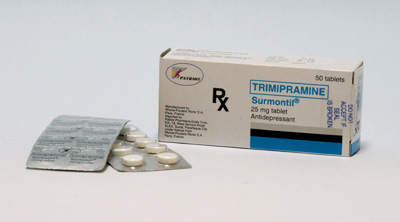
Trimipramine
Surmontil®
Antidepressants increase the risk of suicidal thinking and behavior (suicidality) in children and adolescents with major depressive disorder (MDD) and other "psychiatric disorders" and those considering use of these agents "must balance risk with the clinical need"
FORMULATION:
Each tablet contains Trimipramine (as a maleate).. 25mg
INDICATIONS:
Surmontil has a potent antidepressant action similar to that of other tricyclic antidepressants. It also possesses a pronounced sedative action. It is, therefore, indicated in the treatment of depressive illness, especially where sleep disturbance, anxiety or agitation is a presenting symptom. Sleep disturbance is controlled within 24 hours and true antidepressant action follows within 7-10 days.
PHARMACOKINETICS:
Trimipramine is readily absorbed after oral administration peak plasma concentrations being obtained in 2 hours. It is metabolized in the liver to its major metabolite desmethyl trimipramine, which is active. Trimipramine is excreted in the urine mainly in the form of its metabolites. It is extensively bound to plasma proteins. The plasma elimination half-life is reported to be about 23 hours.
CONTRAINDICATIONS:
Surmontil is contraindicated in cases of known hypersensitivity to the drug. The possibility of cross-sensitivity to other dibenzazepine compounds should be kept in mind. Surmontil should not be given in conjunction with drugs of the monoamine oxidase inhibitor class. The concomitant use of monoamine oxidase inhibitors (MAQI) and tricyclic compounds similar to Trimipramine has caused severe hypepyretic reactions, convulsive crises and death in some patients. At least two weeks should be elapse after cessation of therapy with MAQI before instituting therapy with trimipramine. Initial dosage should be low and increased gradually with caution and careful observation to the patient. The drug is contraindicated during acute recovery period after a myocardial infarction.
WARNINGS:
Extreme caution should be used when this drug is given to patients with any evidence of cardiovascular disease because of the possibility of conduction defects, arrhythmias, myocardial infarction, strokes and tachycardia. Caution is advised in patients wit increased intraocular pressure, history of urinary retention, or history of narrow-angle glaucoma because of the drug's anticholinergic properties; hyperthyroid patients or those on thyroid medication because of the possibility of cardiovascular toxicity; patients wit a history of seizure disorder because this drug has been shown to lower seizure threshold; patients receiving guanethidine or similar agents, since trimipramine may block the pharmacologic effects of these drugs. Since the drug may impair the mental and/or physical abilities required for the performance of potentially hazardous tasks, such as operating an automobile or machinery, the patients should be cautioned accordingly.
DRUG INTERACTIONS:
Cimetidine: There is evidence that cimetidine inhibits the elimination of trycyclic antidepressants. Downward adjustment of Trimipramine dosage may be required if cimetidine therapy is initiated; upward adjustment if cimetidine therapy is discontinued.
Alcohol: Patients should be warned that the concomitant use of alcoholic beverages may be associated with exaggerated effects.
Catecholamines/Anticholinergics: It has been reported that tricyclic antidepressants can potentate the effects of catecholamines. Similarly, atropine-like effects may be more pronounced in patients receiving anticholinergic therapy. Therefore, particular care should be exercised when it is necessary to administer tricyclic antidepressants with sympathomimetic amines, local decongestants, and local anesthetics containing epinephrine, atropine or drugs with anticholinergic effect. In resistant cases of depression of adults, a dose of 2.5mg/kg/day may have to be exceeded. If a higher dose is needed, ECG monitoring should be maintained during the initiation of therapy and at appropriate intervals during stabilization dose.
Drug metabolized by P4502D6
The biochemical activity of the drug metabolizing isozyme cytochrome P450 2D6 (debrisoquin hyroxylase) is reduced in a subset of the Caucasian population about 7-10% of Caucasians are so called poor metabolizers; reliable estimates of the prevalence of reduced P450 2D6 isozyme activity among Asian, African and other populations are not yet available. Poor metabolizers have higher than expected plasma concentrations of tricyclic antidepressants (TCAs) when given usual doses. Depending on the fraction of drug metabolized by P450 2D6, the increase in plasma concentrations may be small, or quite large (8 fold increased in plasma AUC of the TCA). In addition, certain drugs inhibit the activity of the isozyme and make normal metabolizers resemble poor metabolizers. An individual who is stable on a given dose of TCA may become abruptly toxic when given one of these inhibiting drugs as concomitant therapy. The drugs that inhibit cytochrome P450 2D6 include some that are not metabolized by the enzyme (quinidine and cimitidine) and many that are substrates for P450 2D6. While all the selective serotonin reuptake inhibitors (SSRIs) eg. Fluoxetina, sertraline and paroxetine, inhibit P450 2D6, they may vary in the extent of inhibition. The extent of which SSRI TCA interactions may pose clinical problems will depend on the degree of inhibition and pharmacokinetics of the SSRI involved. Nevertheless, caution is indicated in the co-administration of TCAs with any of the SSRIs and also in switching from one class to the other. Of particular importance, sufficient time must elapse before initiating TCA treatment in a patient being withdrawn from fluoxetine, given the long half-life of the parent and active metabolite (at least 5 weeks may be necessary). Concomitant use of tricyclic antidepressants with drugs that can inhibit cytochrome P450 2D6 may require lower dose than usually prescribed for either the tricyclic antidepressants or the other drug. Furthermore, whenever one of these other drugs is withdrawn from co-therapy, an increased dose of tricyclic antidepressant may be required. It is going to be co-administered with another drug known to be an inhibitor of P450 2D6.
CARCINOGENESIS, MUTAGENESIS, IMPAIRMENT OF FERTILITY
Semen studies in man (4 schizopherenics and nine normal volunteers) revealed no significant changes in sperm morphology. It is recognized that drugs having a parasympathetic effects, including tricyclic antidepressants, may alter the ejaculatory response.
PREGNANCY
Surmontil has shown evidence of embryotoxicity and/or increased incidence of major anomalies in rats at dose 20 times the human dose. There are no adequate and well controlled studies in pregnant women. Trimipramine should be used during pregnancy only if potential benefits justify the potential risk to the fetus.
PEDIATRIC USE:
This drug is not recommended for use in children, since safety and effectiveness in the pediatric age group have not been established.
GERIATRIC USE:
Clinical studies of trimipramine maleate were not adequate to determine whether subjects aged 65 and over respond differently from younger subjects. Trimipramine is known to be substantially excreted by the kidneys. Clinical circumstances, some of which may be more common in elderly, such as hepatic or renal impairment, should be considered. Greater sensitivity of some older individuals cannot be ruled out. In general, dose selection for elderly patients should be cautious, usually starting at a lower dose.
CAUTION:
Food, Drugs, Devices and Cosmetic Acts prohibits dispensing without prescription.
ADVERSE REACTIONS:
Note: The pharmacological similarities among the tricyclic antidepressants require that each of the reactions be considered when Surmontil is administered. Some of the adverse reactions included in this listing have not in fact been reported with Surmontil.
Cardiovascular: Hypotension, hypertension, tachycardia, palpitation, myocardial infarction, arrhythmias, heart block, stroke.
Psychiatric: Confusional states (especially the elderly) with hallucinations, disorientation, delusions, anxiety, restlessness, agitation, insomnia and nightmare, hypomania, exacerbation of phychoses.
Neurolgical: numbness, tingling, paresthesias of extremities, incoordination, ataxia, tremors, peripheral neurophathy, extrapyramidal symptoms, seizures, alterations in EEG patterns, tinnitus, syndrome of inappropriate ADH (antidiuretic hormone) secretion.
Anticholinergic: Dry mouth and rarely associated sublingual adenitis, blurred vision, disturbances of accommodation, mydriasis, constipation, paralytic ileus, urinary retention, delayed micturition, dilation of the unirary tract.
Allergic: Skin rash, reptechiae, urticaria, itching, protosentization, edema of the tongue and face.
Hetamotologic: Bone marrow depression including agranulocytosis, esosinophilia, purpura, thrombocytopenia, leukocyte, and differential counts should be performed in any patients who develops fever and sore throat during therapy; the drug should be discontinued if there is evidence of pathological neutrophil depression.
Gastrointestinal: Nausea and vomiting, anorexia, epigastric, distress, diarrhea, peculiar taste, stomatitis, abdominal cramps, black tongue.
Endocrine: Gynecomastia in the male, breast enlargement and galactorrhea in the female; increased or decreased libido; impotence; testicular swelling, elevation or depression of blood sugar levels.
Other: Jaundice (simulating obstructive); altered liver function; weight gain or loss; perspiration; flushing; urinary frequency; drowsiness, dizziness, weakness and fatigue, headache, paratid swelling; alopecia.
Withdrawal symptoms: Though not indicative of addiction, abrupt cessation of treatment after prolonged therapy may produce nausea, headache and malaise.
DOSAGE AND ADMINISTRATION:
Dosage should be initiated at a low level and increased gradually, noting carefully the clinical response and any evidence of intolerance. Lower dosages are recommended for elderly patients and adolescents. Lower dosages are also recommended for outpatients as compared to hospitalized patients who will be under close supervision. It is not possible to prescribe a single dose schedule of surmontil that will be therapeutically effective in all patients. The physical psychodynamic factors contributing to depressive symptomatology are very complex; spontaneous remissions or exacerbations of depressive symptoms may occur with or without drug therapy. Consequently, the recommended dosage regimens are furnished as a guide, which may be modified by factors such as age of the patients, chronicity and severity of the disease, medical condition of the patient, and degree of psychotherapeutic support. Most antidepressant drugs have a lag period of ten days to four weeks before a therapeutic response is noted. Increasing the sode will not shorten this period but rather increase the incidence of adverse reactions.
Usual Adult Dose:
Outpatients: Initially, 75mg/day in divided doses, increased to 150mg/day. Dosages over 200mg/day are not recommended. Maintenance therapy is in the range of 50 to 150mg/day. For convenient therapy and to facilitate patient compliance, the total dosage requirement may be given at bedtime.
Hospitalized patients: Initially, 100mg/day in divided doses. This may be increased gradually in a few days to 200mg/day, depending upon the individual response and tolerance. If improvement does not occur in 2 to 3 weeks, the dose may be increased. Adolescent and Geriatric Patients: Initially, a dose of 50mg/day is recommended, with gradual increments up to 100mg/day, depending upon patients response and tolerance.
Maintenance: Following remission, maintenance medication may be required for a longer period of time, at the lowest dose that will maintain remission. Maintenance therapy is preferably administered as a single dose at bedtime. To minimize relapse, maintenance therapy should be continued for about three months.
Availability: Box of 50 tablets in blisters.
STORE AT TEMPERATURE NOT EXCEEDING 30 0C
|
|