Natrapharm Home | Contact Us | Sitemap    
   Patriot Pharmaceutical Corp.   
Products

Natrapharm, Inc.

Patriot Pharmaceutical Corp.
 
Home » Products » Fibrafen


FENOFIBRATE

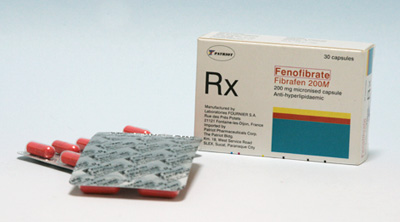
FIBRAFEN® 200 M

200 mg Micronised Capsule


PRODUCT IDENTIFICATION

NAME: Fibrafen 200 M, capsule.
Formulation: each capsule contains Fenofibrate (INN): 200mg.
Sodium laurilsulphate, lactose, pregelatinised starch, crospovidone, magnesium stearate.
Capsule shell: gelatin, titanium dioxide (E 171), iron oxide (E 172), erythrosine (E 127)>

PHARMACEUTICAL FORM Hard capsule.
PHARMACO-THERAPEUTIC CLASS SERUM LIPID REDUCING AGENTS / CHOLESTEROL AND TRIGLYCERIDES REDUCERS / FIBRATES.

CLINICAL DATA
THERAPEUTIC INDICATIOS
Hypercholesterolemia (type lla) and endogenous hypertriglyceridaemia in adults, isolated (type V) or associated (types Iib and III):
- when an appropriate and assiduous diet has been followed, but has not been sufficient,
- especially when the cholesterolaemia remains elevated after the diet, and/or when there are associated risk factors.

It is always essential to continue the diet. Currently, there are no long-term controlled trials showing the efficacy of fenofibrate in the primary or secondary prevention of the complications of atherosclerosis.

DOSAGE AND ROUTE OF ADMINISTRATION
In association with the diet, this medical product constitutes a long-term symptomatic treatment whose efficacy must be monitored periodically.
- The capsules of micronised fenofibrate 200 must only be administered as 1 capsule daily during one of the main meals in patients requiring this form, which is equivalent to 3 capsules of micronised fenofibrate 67.
- It is recommended to reduce the dosage by prescribing 2 capsules daily of micronised fenofibrate 67 whenever the cholesterol level has been normalized.

CONTRAINDICATIONS
This medical product should never be prescribed in the following situations:
- hepatic insufficiency,
- renal insufficiency
- in association with another fibrate
- in children

This medicine is usually not advised in association with inhibitors of HMG-CoA reductase

WARNINGS AND SPECIAL PRECAUTIOS FOR USE
Warnings: Muscular involvements, including rare cases of rhabdomyolsis, have been reported with fibrates. The may happen more frequently when plasma albumin is low. Muscular involvements should be considered in all patients with diffuse myalgia, muscles painful to touch, and/or a large increase in CPK of muscle origin (level above 5 times the normal level), in which cases, treatment should be stopped.

Furthermore, the risk of muscle involvements can be increased when taken in association with another fibrate or with an inhibitor of HMG-CoA reductase.

Precautions for use:
- if after a period administration of several months (3 to 6 months), a satisfactory reduction of serum lipids has not been obtained, a complementary or different therapeutic approach should be envisaged.
- Elevated transminases have been observed, usually transitory, in some patients. In the present state of knowledge, these appear to justify:
  • A systematic check of transaminases every three months during the first 12 months of treatment.
  • A cessation of treatment in the event that ASAT and ALAT are increased more than 3 times the upper limit of normal.
- in the case of co-medication with oral anticoagulants, close monitoring of the prothrombin level is necessary, expressed as INR.

DRUG INTERACTIONS
Combinations that are contra-indicated

Other fibrates: increased risk of adverse events such as rhabdomyolysis.

Inadvisable combination

Inhibitors of HMG-CoA reductase: increased risk of muscular adverse events.

Combinations subject to precautions for use

Oral anticoagulants: increase the effect of the oral anticoagulant with the risk of haemorrhage (due to their displacement from plasma proteins).

More frequent checks on the prothrombin index is necessary expressed as INR and the adjustment of the dose of oral anticoagulant during the treatment with fenofibrate and for 8 days after stopping it.

PREGNANCY - BREASTFEEDING

Pregnancy
- The results of animal studies have not revealed any teratogenic effect.
- Clinically, no teratogenic or embryotoxicity effect has appeared to date. However, the follow-up of pregnancies exposed to fenofibrate is insufficient to exclude any risk.
- There is no indication for the prescription of major hypertrigylceridaemis (>10g/l) insufficiently lowered with diet, and which increase the mother's exposure to a risk of acute pancreatitis.

Lactation
There is no information on the passage of fenofibrate into maternal milk. Prescription is contra-indicated during the period of breast-feeding.

ADVERSE EFFECTS
- As with other fibrates, cases of muscle involvements (diffuse myalgia, painful sensations, weakness) as well as rare cases of rhabdomyolysis, sometimes severe, have been reported. They are most often reversible when treatment is stopped.
- Other, less frequent and of moderately intense adverse events have also been reported: gastric or intestinal digestive disorders, such as dyspepsia, elevated transaminases, skin allergic reactions. To date there are no controlled studies to globally assess adverse events on the long term, and more especially the risk of cholelithiasis.

OVERODOSE
Symptomatic treatment

PHARMACOLOGICAL PROPERTIES
Fenofibrate can lower serum cholesterol by 20 to 25%, and triglycerides by 40 to 50%.
- Cholesterol reduction is obtained by lowering low density atherogenic fractions (VLDL and LDL). This improves the distribution of plasma cholesterol by reducing the ratio of total cholesterol/HDL cholesterol, which is increased during the course of atherogenic hyperlipidaemias.
- The relationship between hypercholesterolemia and atherosclerosis has been established, as well as the relationship between atherosclerosis and coronary risk. Low levels of HDL are associated with an increased coronary risk. Increased triglycerides levels are associated with increased vascular risk, but it cannot be certain that this relationship is independent from other risk factors. Furthermore, triglycerides might be involved not only in the atherogenic process, but also in thrombogenesis.
- Extravascular deposits of cholesterol (tendinous and tuberous xanthomas) may, with an effective prolonged treatment (a large reduction in cholesterolaemia) be markedly reduced, and even disappear totally.
- A uricosuric effect has been shown in hyperlipidaemic patients, leading to an average reduction of 25% in plasma uric acid.
- The increase in apoA1 and the reduction in apoB observed on treatment with fenofibrate improves the apo A1/apo B ratio, which can be considered as a marker of atherogenic risk.
- A clinical trial demonstrated a platelet anti-aggregant effect of fenofibrate in animals and in man as shown by a reduction in aggregation caused by ADP, arachidonic acid, and epinephrine.
- Through activation of the a-type Peroxysome Proliferator Activated Receptor type ?(PPAR ?), fenofibrate increases lipolysis and the clearance of triglyceride-rich particles from plasma by activating lipoprotein lipase and reducing the product of apolipoprotein C III.

PHARMACOKINETICS PROPERTIES
The unchanged product is not found in plasma. The major metabolite is fenofibric acid.

Maximal plasma concentration is reached usually 5 hours after ingestion of the medicine. Mean plasma concentration is approximately 15mg/mL with a dose of one capsule/day of micronised fenofibrate 200, or 3 capsules/day of micronised fenofibrate 67. In the same subject on continuous treatment, plasma levels are stable. Fenofibric acid is strongly bound to plasma albumin, and can displace vitamin K antagonists from protein binding sites, and potentiate their anticoagulant effects.

The half-life elimination of fenofibric acid is approximately 20 hours.

The excretion is essentially in the urine: almost the entire product is eliminated in 6 days. Fenofibrate is principally excreted in the form of fenofibric acid and its glucuronide derivative.

Kinetic studies, following the administration of a single dose and continuous treatment have demonstrated that the drug does not accumulate. Fenofibric acid is not eliminated by haemodialysis.

AVAILABILITY
Box of 30 capsules in thermoformed blister strips.

PRESCRIPTION AND DISPENSING CONDITIONS
Prescription-only medication.


STORAGE
Store in the original package at a temperature not exceeding 30oC. Keep in a dry place.

CAUTION
Foods, Drugs, Devices and Cosmetics Act prohibits dispensing without prescription.
The Company

Corporate Services

Careers at Natrapharm
Home | The Company | Corporate Values | Corporate Services | Products | About the Philippines | Careers | Contact Us | Sitemap

©2008 . Powered by ASPAC/LAW